Blog
PDRN at home: do PDRN and exosome ampoules and serums work?
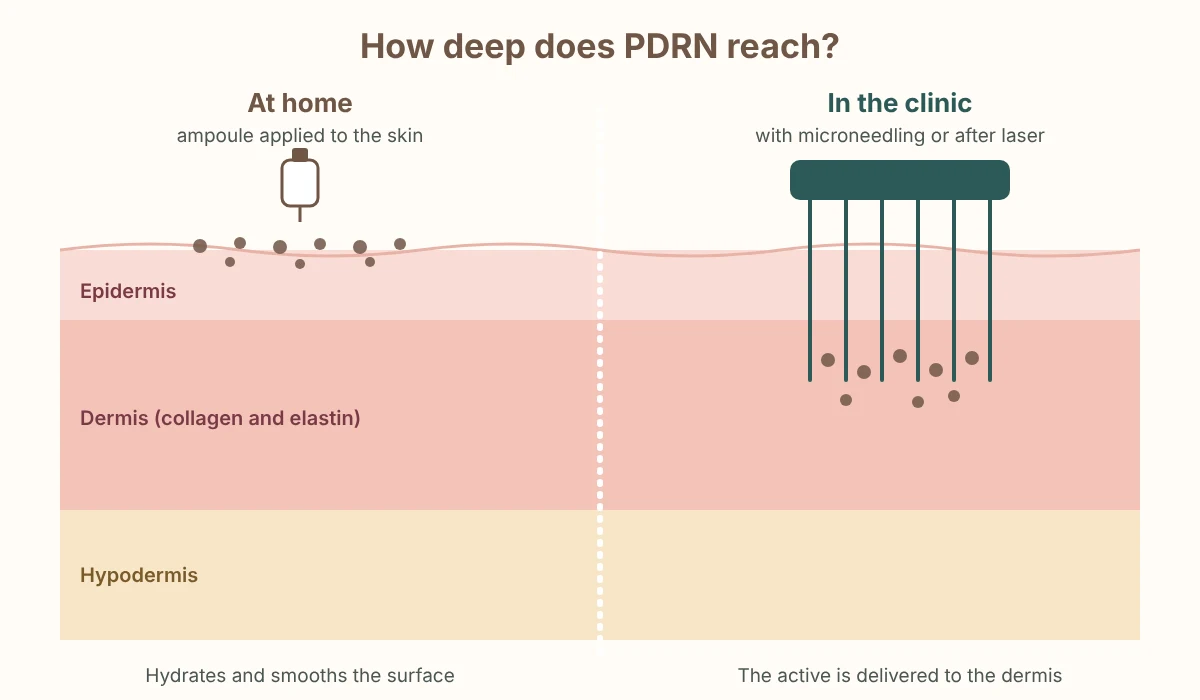
Since salmon PDRN became popular, many ampoules, serums and kits for home use have appeared, a lot of them Korean and combined with exosomes. The question we hear most in the clinic is whether they work the same as the in-clinic treatment. The short answer: they are not the same, but they can have their place.
Why it is not the same
The skin is a very effective barrier: it easily lets small molecules through, but holds back large ones. PDRN is a large molecule (DNA fragments), much bigger than what intact skin lets through on its own. That is why, in the clinic, we apply it with microneedling or after a fractional laser or microneedling radiofrequency: these procedures open tiny channels so the active can reach the dermis, where collagen and elastin are found (you can see it in the diagram at the top).
Most of the solid clinical studies on PDRN use it injected or with microneedles. For topical products the evidence is still scarce and depends a lot on each formula: most brands do not disclose the size of the molecule or how they make it penetrate.
What about exosomes
Exosomes are tiny vesicles that cells use to communicate; they carry proteins, lipids and other molecules. In dermatology they are being studied for skin regeneration and some inflammatory conditions. The most recent reviews consider them promising, but with studies that are still small and short. In at-home cosmetics, the quality and origin of exosomes vary a lot from one product to another.
What an at-home ampoule can do
Hydrate
Many of these products include hyaluronic acid and other humectants: skin feels more hydrated and supple.
Radiance and smoothness
With consistent use, skin can look more even and feel smoother to the touch.
Maintenance
They can complement in-clinic sessions. Ask your dermatologist whether that applies to you.
What an at-home ampoule does not do is replace a medical treatment. If you are concerned about acne, scars, dark spots or noticeable sagging, the right step is a dermatology assessment.
At home or in the clinic
At home
On clean skin, morning and night, for 2 to 6 weeks. It works on the surface layers: hydration, radiance, smoothness. No downtime, and available wherever you are.
In the clinic
With microneedling or after laser, by medical staff and after an assessment. PDRN reaches the dermis: deeper changes in texture, firmness and skin quality. Usually 3 to 5 sessions, with mild redness for 3 to 5 days.
It is not about which one is "better", but about what you are looking for: an at-home care routine or a medical procedure for a more visible change. You can learn about the in-clinic treatment in the article Salmon PDRN: benefits, treatment and sessions.
Precautions if you use it at home
Don't use a dermaroller at home
Some brands suggest using a dermaroller or dermapen to help the product penetrate. Microneedling without the hygiene and technique of a clinic can cause infections, irritation or dark spots.
Do a patch test first
Apply a little behind your ear or on your forearm and wait 24 hours before using it on your whole face.
Fish or shellfish allergy
PDRN comes from salmon. If you are allergic, ask before using it.
Pregnancy, breastfeeding and irritated skin
Ask before using it during pregnancy or breastfeeding, and do not apply it to injured, sunburned or recently treated skin.